


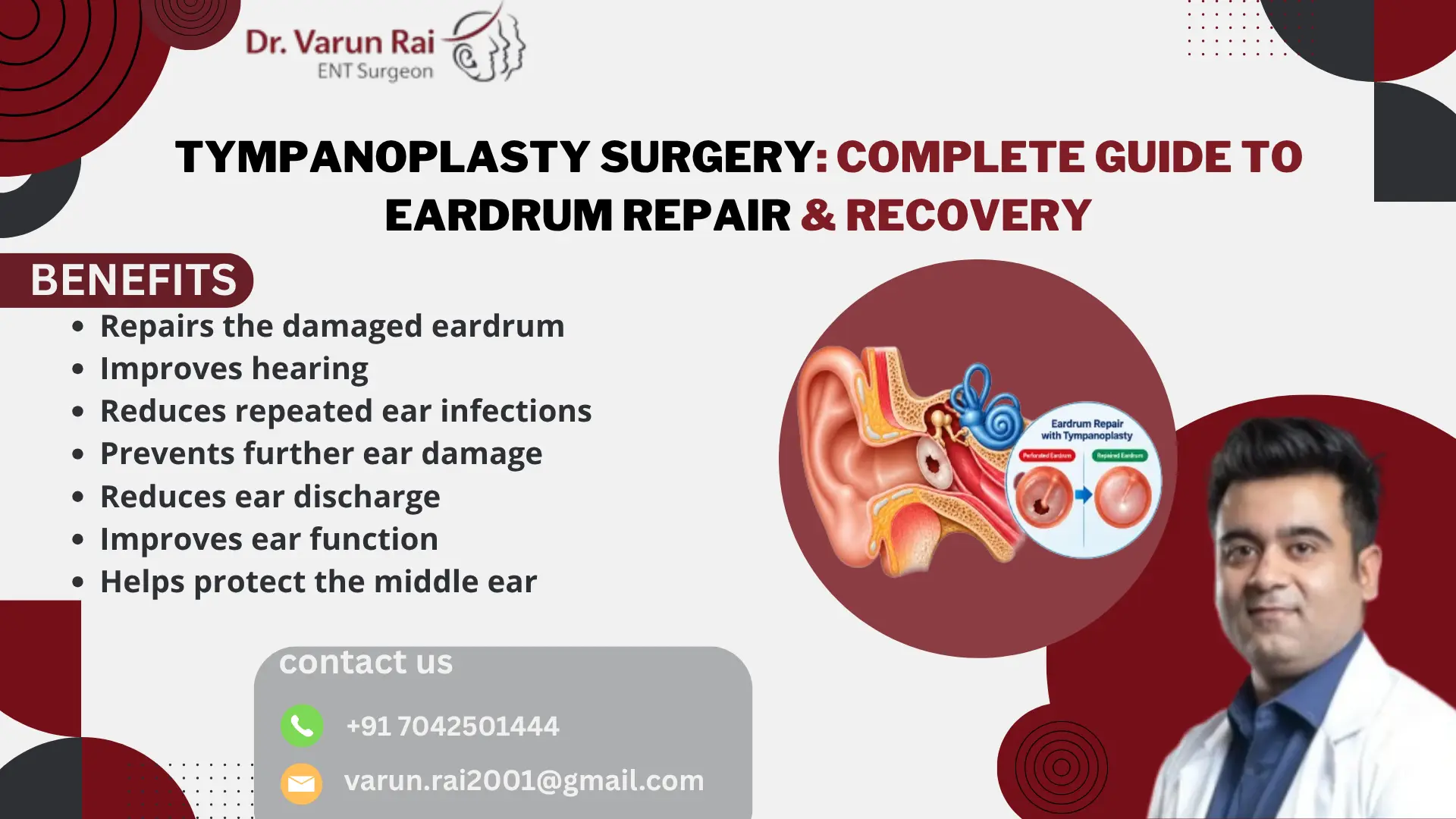
A damaged or perforated eardrum can affect much more than hearing. It may lead to repeated ear discharge, infections, discomfort, difficulty hearing conversations, and restrictions on activities such as swimming. When a perforation does not heal on its own or is associated with ongoing middle-ear disease, Tympanoplasty Surgery may be recommended to repair the eardrum and, when necessary, reconstruct the tiny bones responsible for sound transmission.
Get Expert Tympanoplasty Surgery Guidance — Book Your Consultation or WhatsApp Us Today.
The eardrum, medically known as the tympanic membrane, separates the ear canal from the middle ear and plays an important role in hearing. A persistent perforation can interfere with its normal vibration and can also allow water and bacteria to enter the middle ear. Modern ear surgery uses delicate grafting and microsurgical or endoscopic techniques to restore the structure and function of the ear.
This comprehensive guide explains why Tympanoplasty Surgery may be required, how doctors diagnose eardrum problems, what happens during the procedure, the benefits, recovery expectations, risks, and factors that influence Tympanoplasty Cost.
Symptoms and Causes of Eardrum Damage
A perforated eardrum does not always cause the same symptoms. Some people notice a sudden change in hearing, while others experience recurring discharge or infections over months or years.
Common symptoms
Symptoms that may indicate an eardrum perforation or middle-ear problem include:
- Reduced or muffled hearing
- Recurrent ear discharge
- Earache or discomfort
- Ringing or buzzing in the ear (tinnitus)
- A feeling of pressure or fullness
- Repeated ear infections
- Occasional dizziness
- Difficulty hearing speech, particularly in noisy environments
- Sensitivity to water entering the ear
Persistent hearing loss or recurrent infections should be evaluated by an ENT specialist rather than managed with home remedies alone.
Common causes
An eardrum can become damaged for several reasons:
- Chronic or recurrent middle-ear infections
- Previous ear surgery
- Direct trauma to the ear
- Insertion of objects or cotton buds into the ear canal
- Sudden pressure changes, such as barotrauma
- Severe infection causing the eardrum to rupture
- Head or ear injuries
Small perforations can sometimes close naturally. However, when a perforation remains persistent—particularly when accompanied by hearing loss or recurrent infection—an ENT evaluation can determine whether surgical repair is appropriate.
Diagnosis and Tympanoplasty Surgery Planning
Before recommending Tympanoplasty Surgery, an ENT specialist needs to understand the size and location of the perforation, the condition of the middle ear, hearing status, and whether the tiny hearing bones are affected.
Ear examination
The doctor usually examines the ear using an otoscope or microscope. This allows the specialist to identify the perforation and look for infection, inflammation, scarring or other abnormalities.
Hearing assessment
An audiogram is commonly performed to determine the degree and type of hearing loss. The AAO-HNS clinical indicators for tympanoplasty include air- and bone-conduction hearing assessment as part of the preoperative evaluation.
Additional investigations
Depending on the individual condition, the ENT specialist may recommend additional tests or imaging. These may be particularly important when chronic middle-ear disease, mastoid disease or cholesteatoma is suspected.
The decision to operate is individualized. A persistent perforation, recurrent infections, conductive hearing loss, or difficulty keeping the ear protected from water may be among the reasons surgery is considered.
What is Tympanoplasty Surgery?
Tympanoplasty Surgery is an operation designed to repair the eardrum and, when required, reconstruct or address structures within the middle ear. It differs from myringoplasty, which is generally limited to repair of the eardrum itself.
The exact technique depends on the patient’s anatomy and disease.
Treatment, Procedure, Benefits and Recovery
The primary objective of Tympanoplasty Surgery is to create a healthy, closed ear and improve or preserve hearing where possible. The procedure may be performed through the ear canal or through an incision behind the ear, depending on the surgical approach required.
How the procedure is performed
Although the exact steps vary, the procedure generally involves:
- Anaesthesia: The patient receives appropriate anaesthesia based on the surgical plan.
- Access to the eardrum: The surgeon reaches the damaged area through the ear canal or via an incision behind the ear.
- Preparation of the perforation: Diseased or unhealthy tissue may be carefully removed.
- Graft placement: A suitable tissue graft is positioned to close and support the eardrum.
- Middle-ear reconstruction: If the small hearing bones are damaged, reconstruction may be performed using tissue or an appropriate prosthesis.
- Packing and closure: The ear may be packed to support healing, and any incision is closed appropriately.
Tympanoplasty can therefore range from a relatively straightforward eardrum repair to a more complex reconstruction involving the middle ear or mastoid, depending on the underlying disease.
Benefits of Tympanoplasty Surgery
Potential benefits include:
- Closing a persistent eardrum perforation
- Reducing recurrent ear discharge and infections
- Protecting the middle ear from water and contamination
- Improving conductive hearing loss when the hearing mechanism is suitable for reconstruction
- Creating a healthier and safer ear
- Addressing associated middle-ear disease when necessary
The expected hearing improvement varies between patients. AAO-HNS patient information notes that good outcomes can be expected in many cases, but results depend on factors such as the severity of disease and the condition of the middle-ear structures.
Tympanoplasty Cost
Patients often search for Tympanoplasty Cost before planning treatment. However, there is no single price that applies to every patient.
The final cost can depend on:
- Type and complexity of tympanoplasty
- Size and location of the perforation
- Surgeon and hospital charges
- Anaesthesia expenses
- Diagnostic tests
- Whether ossicular reconstruction is required
- Whether mastoid surgery is also necessary
- Type of graft or prosthesis used
- Postoperative medicines and follow-up
Published Delhi estimates vary substantially because procedures and hospital packages differ. For example, some Delhi sources report approximate ranges from ₹30,000–₹85,000, while another hospital source reports approximately ₹50,000–₹90,000. These figures should not be treated as a personalized quote.
A consultation and examination are therefore the best way to determine the appropriate treatment and expected Tympanoplasty Cost for an individual patient.
Recovery after Tympanoplasty Surgery
Recovery is gradual. Mild pain, pressure, crackling sounds, temporary drainage and reduced hearing can occur during the early healing period. Cleveland Clinic notes that hearing may remain reduced for several weeks, while complete hearing recovery can take longer depending on the surgery.
Patients are commonly advised to:
- Keep the operated ear dry as instructed
- Avoid swimming until the ENT specialist confirms it is safe
- Avoid heavy lifting and strenuous exercise during the recommended period
- Avoid forceful nose blowing
- Sneeze with the mouth open
- Take prescribed medicines exactly as directed
- Attend scheduled follow-up visits
- Avoid putting anything into the operated ear unless instructed
Johns Hopkins Medicine similarly recommends keeping the ear dry for several weeks and avoiding swimming for around four to six weeks, although the exact timeline should always follow the operating surgeon’s instructions.
Most people recover from the immediate effects of surgery within around two weeks, but internal healing and hearing improvement can continue for considerably longer.
Risks and when to contact your doctor
Like any surgery, Tympanoplasty Surgery has potential risks. These may include persistent perforation, infection, dizziness, tinnitus, changes in taste, hearing changes or failure to achieve the expected hearing improvement. Serious complications such as facial nerve injury are uncommon but recognized risks.
Contact your ENT surgeon promptly if you experience severe or worsening pain, significant bleeding or discharge, high fever, marked dizziness, facial weakness, or another unexpected symptom.
Comparison: Tympanoplasty vs Myringoplasty
Although the terms are sometimes used interchangeably, there is a distinction.
| Feature | Tympanoplasty | Myringoplasty |
| Main purpose | Repairs eardrum and may address middle-ear structures | Primarily repairs the eardrum |
| Middle-ear reconstruction | May be required | Usually not the main objective |
| Ossicular repair | May be included | Generally not included |
| Suitable for | More complex eardrum/middle-ear disease | Selected eardrum perforations |
| Surgical complexity | Depends on disease | Usually more limited |
The American Academy of Otolaryngology–Head and Neck Surgery specifically distinguishes myringoplasty, which is confined to the drumhead and donor area, from tympanoplasty, which can involve the tympanic membrane and middle-ear structures.
About Dr. Varun Rai and ENT Services
Dr. Varun Rai is a Consultant in ENT at Sir Ganga Ram Hospital, New Delhi. His professional training includes senior residency at Maulana Azad Medical College, a visiting fellowship at the University of Milan in sialendoscopy and minimally invasive salivary-gland surgery, and training related to skull-base surgery at IRCAD Strasbourg, France. His listed clinical interests include micro ear surgery and middle-ear implants, along with endoscopic sinus and skull-base surgery, sialendoscopy, and voice and swallowing disorders.
His ENT-related services include evaluation and management of ear, nose, throat and related head-and-neck conditions, with particular interests in areas such as:
- Micro ear surgery
- Middle-ear procedures
- Tympanoplasty and eardrum-related problems
- Middle-ear implants
- Endoscopic sinus and skull-base surgery
- Sialendoscopy and salivary-gland disorders
- Voice and swallowing disorders
For patients considering Tympanoplasty Surgery, a specialist evaluation is important because the appropriate surgical technique depends on the individual ear condition, hearing status and presence of middle-ear disease.
Frequently Asked Questions About Tympanoplasty Surgery
1. What is Tympanoplasty Surgery?
Tympanoplasty Surgery is an operation performed to repair a perforated or damaged eardrum and, when necessary, reconstruct structures within the middle ear. The aim is to create a healthy ear and potentially improve hearing.
2. Is tympanoplasty the same as eardrum repair surgery?
They are closely related terms. Eardrum Repair Surgery generally refers to repairing the tympanic membrane, while tympanoplasty can include eardrum repair as well as reconstruction of middle-ear structures when required.
3. How long does recovery take after Tympanoplasty Surgery?
Initial recovery may take around 10 days to two weeks, but the eardrum and middle-ear structures continue healing afterward. Hearing can take several weeks or longer to fully stabilize.
4. Can tympanoplasty improve hearing?
It can improve hearing when the hearing loss is caused by a repairable conductive problem. However, the amount of improvement depends on the condition of the eardrum, middle-ear bones and inner ear.
5. Is Tympanoplasty Surgery painful?
Some pain, pressure or discomfort is normal during the early recovery period. Pain is generally manageable with medication prescribed or recommended by the treating doctor.
6. How much does Tympanoplasty Cost in Delhi?
Tympanoplasty Cost varies according to the complexity of surgery, hospital, surgeon, anaesthesia, investigations and whether additional procedures are required. Published estimates vary considerably, so patients should obtain an individualized quotation after examination.
7. Can I swim after tympanoplasty?
Swimming should generally be avoided until the surgeon confirms that the ear has healed sufficiently. Some medical guidance recommends avoiding swimming for approximately four to six weeks, but your ENT specialist’s instructions should take priority.
8. Will the eardrum heal without surgery?
Some small perforations may heal naturally, particularly when the underlying cause is appropriately treated. If a perforation remains persistent for months or is associated with hearing loss or recurrent infections, surgical repair may be considered.
9. What happens if a perforated eardrum is left untreated?
A persistent perforation can increase the risk of recurrent middle-ear infection, ongoing drainage and conductive hearing loss. An ENT evaluation helps determine whether observation, medical treatment or surgery is appropriate.
10. How do I know whether I need Tympanoplasty Surgery?
An ENT specialist can determine this after examining the ear and assessing hearing. The decision depends on the size and duration of the perforation, infections, hearing loss, middle-ear condition and overall ear health.
Conclusion
A persistent eardrum perforation should not be ignored, particularly when it causes hearing difficulties, recurrent discharge or repeated infections. Tympanoplasty Surgery offers a well-established surgical approach to repairing the eardrum and, when necessary, addressing problems involving the middle ear.
Successful treatment begins with an accurate diagnosis and an individualized surgical plan. Recovery also requires patience because the eardrum and middle-ear structures may continue healing after the initial postoperative period.
If you have a persistent eardrum hole, recurrent ear discharge, hearing loss or have been advised to consider Eardrum Repair Surgery, consult an experienced ENT specialist rather than delaying evaluation.
For more information or to schedule a consultation, visit Dr. Varun Rai, ENT Specialist, Delhi, and take the first step toward understanding your ear condition and discussing whether Tympanoplasty Surgery is right for you. A personalized evaluation can help determine the most suitable treatment and recovery plan for your needs.

