


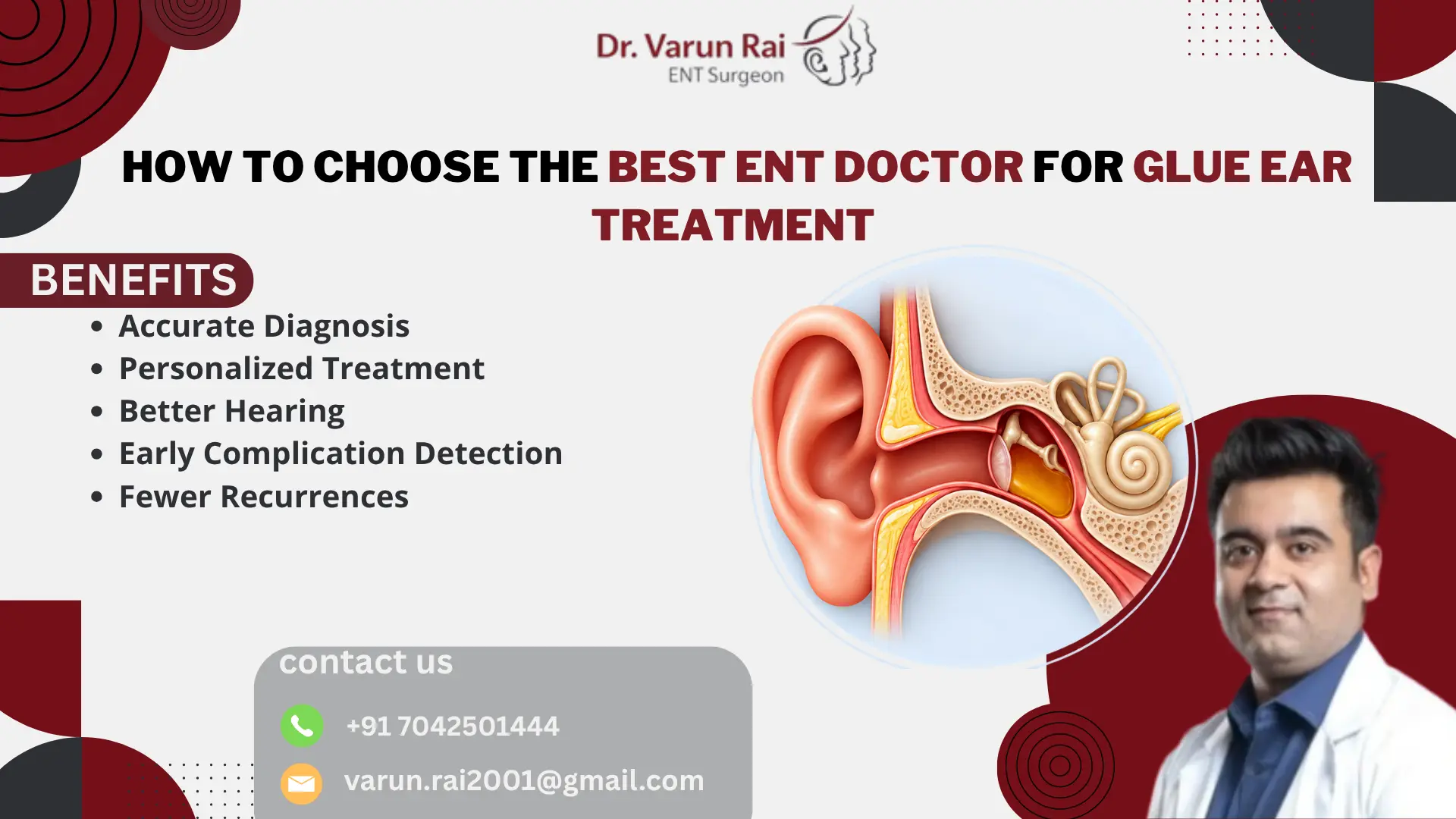
Glue ear, medically known as otitis media with effusion (OME), occurs when fluid builds up behind the eardrum without the signs of an active ear infection. It is particularly common in children and can cause temporary hearing difficulties, a feeling of blocked ears, delayed responses, or problems following conversations. Although glue ear often improves on its own, persistent fluid or hearing loss may require specialist assessment and treatment.
Get Expert Glue Ear Treatment Guidance — Book Your Consultation with Dr. Varun Rai or WhatsApp Us Today.
Choosing the Best ENT Doctor for Glue Ear Treatment is therefore not simply about finding a doctor who treats ear problems. It means selecting an ENT specialist who can accurately diagnose the condition, assess hearing, identify contributing factors, explain whether observation is appropriate, and recommend treatment only when it is medically justified.
Parents should also look for an ENT doctor who communicates clearly, explains treatment alternatives, and provides appropriate follow-up. This guide explains what to consider when choosing the right specialist and what you can expect during evaluation and treatment.
Understanding Glue Ear and Choosing the Right ENT Specialist
What is glue ear?
Glue ear develops when fluid remains in the middle ear, usually without an acute infection. The fluid can reduce movement of the eardrum and interfere with normal sound transmission, resulting in conductive hearing loss.
The condition may occur after an ear infection, during or after a cold, or because the Eustachian tube is not ventilating the middle ear effectively. Children are especially susceptible because their Eustachian tubes are smaller and positioned differently from those of adults.
When searching for the Best ENT Doctor for Glue Ear Treatment, consider whether the doctor has experience managing both straightforward and persistent middle-ear problems.
Symptoms of glue ear
Symptoms can be subtle, particularly in young children. Common signs include:
- Reduced or muffled hearing
- Asking people to repeat themselves
- Speaking louder than usual
- Difficulty following conversations
- Delayed responses to sounds
- A sensation of blocked or full ears
- Poor attention in noisy environments
- Balance difficulties in some children
- Changes in speech or communication when hearing loss persists
A child may not complain about ear symptoms at all. Parents or teachers may instead notice changes in listening or classroom performance.
Causes and risk factors
Several factors can contribute to glue ear, including:
- Previous middle-ear infections
- Colds and upper respiratory infections
- Eustachian tube dysfunction
- Enlarged adenoids
- Allergic or inflammatory nasal conditions
- Exposure to cigarette smoke
- Anatomical factors affecting middle-ear ventilation
Understanding the underlying cause is important because treating the contributing problem may be part of the overall management plan.
How to choose the Best ENT Doctor for Glue Ear Treatment
A good ENT specialist should offer a structured assessment rather than immediately recommending surgery.
Consider these factors:
Relevant ENT experience: Look for an ENT doctor experienced in ear, nose and throat conditions and pediatric or adult middle-ear disorders, depending on the patient’s age.
Diagnostic facilities: Accurate diagnosis may involve examination of the eardrum, tympanometry and hearing assessment. Pneumatic otoscopy is recommended as a primary diagnostic method for OME, while tympanometry can help confirm the diagnosis.
Individualized treatment: Not every patient needs an operation. In children who are not considered at risk, guidelines support observation for around three months because many cases resolve naturally.
Clear communication: The specialist should explain the diagnosis, expected course, treatment choices, benefits and potential risks.
Follow-up care: Persistent fluid should be monitored, particularly when hearing loss or developmental concerns are present.
The Best ENT Doctor for Glue Ear Treatment should focus on the patient’s individual needs rather than using a one-size-fits-all approach.
Diagnosis, Treatment and Procedure Options
Diagnosis of glue ear
The first step is a detailed ENT examination. The doctor may ask about previous ear infections, hearing difficulties, speech development, school performance, nasal symptoms and the duration of the problem.
An otoscope is used to examine the ear canal and eardrum. Pneumatic otoscopy can assess how well the eardrum moves. Tympanometry can provide additional information about middle-ear function, while a hearing test may determine whether the fluid is causing measurable hearing loss.
Hearing evaluation is particularly important when OME is diagnosed because persistent hearing loss can affect communication, learning and day-to-day functioning.
Glue Ear Treatment and watchful waiting
In many children, the first approach is observation rather than immediate intervention. If the child is otherwise healthy and does not have significant hearing, speech, language or developmental concerns, the fluid may clear naturally.
During this period, the ENT specialist may recommend follow-up examinations and hearing assessments.
Parents should not assume that every blocked ear requires antibiotics. Glue ear is different from acute bacterial ear infection, and unnecessary medication should be avoided. Guidelines specifically distinguish OME from acute otitis media and note that treatments such as antihistamines and decongestants are not effective for routine OME management.
When procedures may be considered
If fluid persists and causes significant hearing loss or other problems, an ENT specialist may discuss surgical options.
One established procedure is myringotomy with tympanostomy tube insertion, commonly called ear tube or grommet placement. A small opening is made in the eardrum and a ventilation tube is inserted to help ventilate the middle ear.
Surgery is not automatically required simply because fluid has been present for a certain period. The decision depends on factors such as hearing status, symptoms, developmental risk and whether the condition is persistent.
In selected children, adenoid evaluation or treatment may also be considered when there is a separate indication such as significant nasal obstruction or chronic adenoid disease.
Benefits of specialist-led care
Working with an experienced ENT specialist can provide several advantages:
- More accurate diagnosis
- Appropriate hearing assessment
- Avoidance of unnecessary medication
- Better monitoring of persistent fluid
- Early identification of significant hearing loss
- Individualized decisions about surgery
- Clear explanation of treatment and follow-up
The major benefit of seeing the Best ENT Doctor for Glue Ear Treatment is not necessarily receiving surgery—it is receiving the right treatment at the right time.
Comparing observation and ear tube surgery
| Approach | When it may be considered | Main consideration |
| Observation | Short-duration OME without significant complications | Many cases resolve naturally |
| Hearing monitoring | When fluid persists or hearing is affected | Helps track conductive hearing loss |
| Tympanostomy tubes | Selected persistent cases with significant hearing or related problems | Provides middle-ear ventilation |
| Adenoid treatment | When enlarged or diseased adenoids create a separate indication | Depends on the child’s overall ENT condition |
Your ENT specialist should explain which option is appropriate rather than relying solely on the duration of symptoms.
Recovery, Doctor Expertise and FAQs
Recovery after glue ear procedures
If ear tubes are recommended, the ENT surgeon will explain the procedure, anesthesia, expected recovery and follow-up requirements. Recovery is generally much quicker than major ear surgery, but individual instructions vary.
Parents should attend scheduled follow-up appointments and report persistent ear discharge, worsening hearing, significant pain, fever or other concerning symptoms.
The exact recovery experience depends on the patient’s age, general health, ear condition and procedure performed. Your ENT surgeon should provide personalized postoperative instructions.
About Dr. Varun Rai
Dr. Varun Rai – ENT Surgeon is an ENT and Head & Neck Surgeon associated with Sir Ganga Ram Hospital, Delhi. His professional profile lists MBBS and DNB in Otorhinolaryngology, with experience in ENT care, sinus surgery, ear microsurgery, and voice and swallowing disorders.
Dr. Varun Rai’s practice focuses on advanced ENT care, including sinus surgery, ear procedures and sialendoscopy. His official website describes a patient-focused approach and advanced ENT procedures.
He also has specialized expertise in sialendoscopy. His dedicated sialendoscopy centre reports experience with salivary gland stones, duct narrowing and obstructive salivary gland conditions.
His broader ENT services include:
- Ear evaluation and microsurgical procedures
- Sinus surgery
- Endoscopic ENT procedures
- Sialendoscopy
- Salivary gland stone treatment
- Salivary duct narrowing/stenosis treatment
- Voice and swallowing-related ENT care
- Comprehensive ENT and Head & Neck evaluation
Importantly, expertise in sinus surgery and sialendoscopy does not mean every patient with glue ear requires these procedures. A proper ear examination and hearing assessment should determine the appropriate management.
FAQs
1. Is glue ear the same as an ear infection?
No. Glue ear, or OME, involves fluid in the middle ear without the typical signs and symptoms of acute infection. It should therefore be distinguished from acute otitis media.
2. Does glue ear always require surgery?
No. Many cases resolve naturally, particularly in children without significant risk factors. Observation is commonly recommended initially when appropriate.
3. Can glue ears cause hearing loss?
Yes. Fluid in the middle ear can interfere with sound transmission and cause temporary conductive hearing loss.
4. How is glue ear diagnosed?
Diagnosis generally involves an ENT examination, assessment of the eardrum and, when appropriate, tympanometry and hearing testing.
5. When should I see an ENT doctor for glue ear?
Consider an ENT consultation when hearing difficulties persist, symptoms repeatedly return, there are concerns about speech or learning, or the condition does not improve with observation.
6. Are antibiotics required for glue ear?
Usually, uncomplicated OME is not treated like an acute bacterial ear infection. Your doctor should first establish whether there is an active infection or simply middle-ear fluid.
7. What are ear tubes or grommets?
Tympanostomy tubes, also called ventilation tubes or grommets, are small tubes inserted through the eardrum to help ventilate the middle ear in selected patients.
8. How do I choose the Best ENT Doctor for Glue Ear Treatment?
Look for an ENT specialist who provides accurate diagnosis, hearing assessment, evidence-based treatment, appropriate follow-up and clear communication. Experience with ear disorders is particularly important.
9. Can glue ears affect a child’s learning?
Persistent hearing difficulties can interfere with communication and may affect learning, behavior and confidence. This is why hearing assessment and appropriate monitoring are important.
10. Is every child with persistent glue ear a candidate for ear tubes?
No. The decision depends on hearing levels, duration, symptoms, developmental risk and other individual factors. Treatment should be recommended after a proper ENT assessment.
Conclusion
Choosing the Best ENT Doctor for Glue Ear Treatment requires more than searching for a doctor with a high rating. Look for a qualified ENT specialist who understands middle-ear disorders, performs appropriate diagnostic testing, assesses hearing and recommends treatment based on the individual patient.
The Best ENT Doctor for Glue Ear Treatment will also recognize that observation can be the right choice for some patients, while persistent hearing loss or other complications may require intervention.
If your child or family member has persistent blocked ears, reduced hearing or suspected glue ear, an ENT evaluation can help determine the cause and the most appropriate next step.
Looking for expert ENT care in Delhi? Book a consultation with Dr. Varun Rai, ENT Surgeon, for a comprehensive evaluation and personalized treatment plan. His expertise includes advanced ENT care, sinus surgery, ear procedures and specialized sialendoscopy.
Book an appointment with Dr. Varun Rai
The Best ENT Doctor for Glue Ear Treatment should always prioritize accurate diagnosis, patient safety and appropriate treatment—not unnecessary procedures.

