


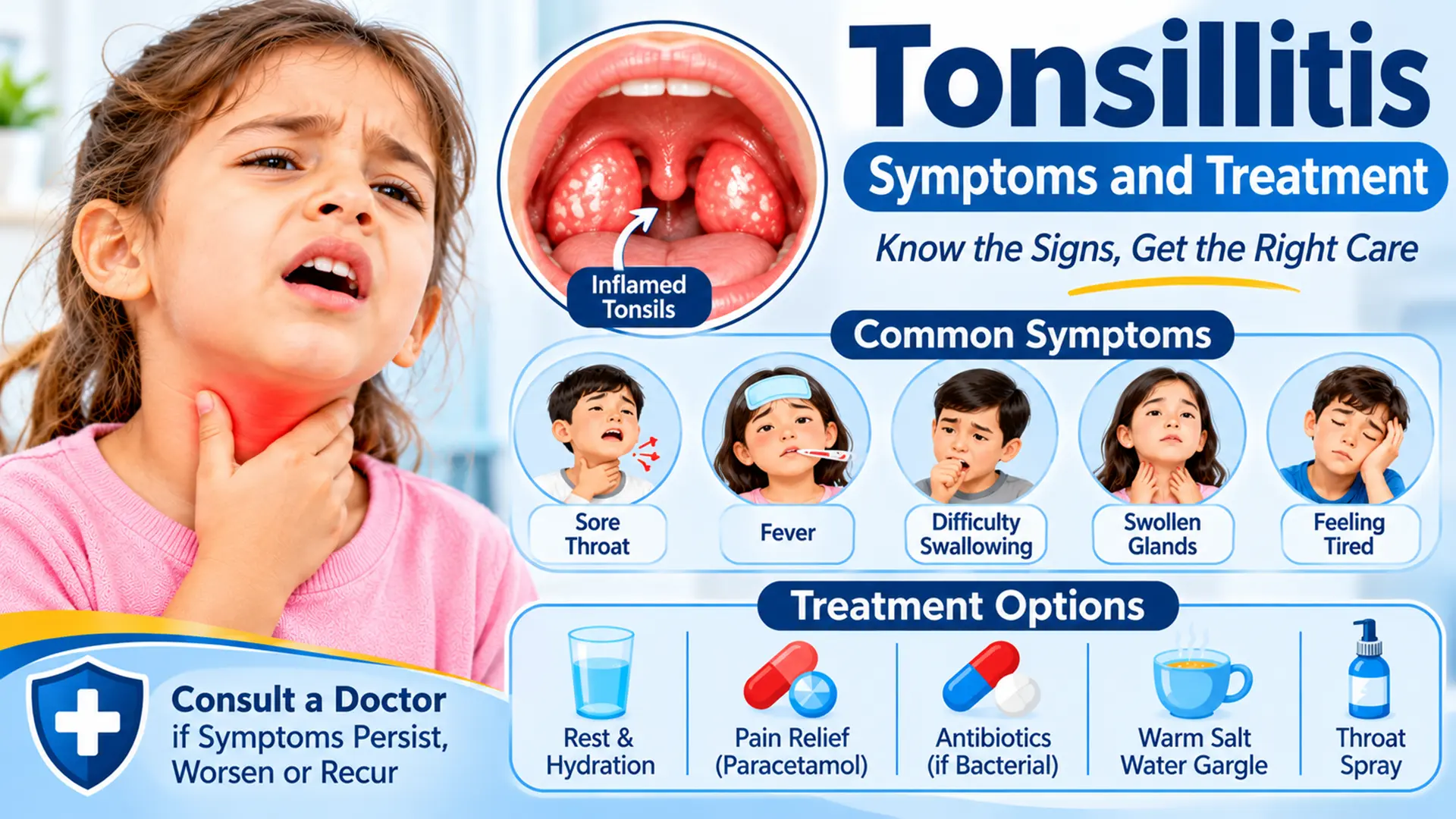
Tonsillitis: Symptoms, Treatment and When to See an ENT Specialist
Tonsillitis is inflammation of the tonsils, usually caused by a virus and less often by bacteria. This guide covers tonsillitis symptoms and treatment. Viral tonsillitis settles on its own with rest, fluids and pain relief, while bacterial tonsillitis, such as strep throat, needs antibiotics to prevent complications. Most cases improve within a few days to about a week. See a doctor if symptoms are severe, last more than a few days, or keep coming back, because repeated episodes are the main reason tonsil removal is ever considered.
What Is Tonsillitis?
The tonsils are two pads of lymphoid tissue at the back of the throat, one on each side. They help the body defend against germs, especially in childhood. When they become infected and inflamed, the condition is called tonsillitis. It is common in children, teenagers and young adults, and most children have at least one episode.
Tonsillitis Symptoms
The usual signs are:
- A sore throat that hurts to swallow
- Red, swollen tonsils, sometimes with white or yellow patches or pus
- Fever
- Tender, swollen glands in the neck
- Earache, headache or bad breath
- In young children: refusing food, drooling, irritability or tiredness
Symptoms usually pass within a few days in most cases. A throat that stays very painful, or symptoms that are getting worse instead of better, call for a medical review.
Viral vs Bacterial Tonsillitis: How to Tell the Difference
Treatment depends on the cause, but the symptoms overlap, so symptoms alone cannot settle it. The clues below are only hints. A throat swab or rapid strep test is the only way to be sure.
| Feature | More typical of viral tonsillitis | More typical of bacterial (strep) tonsillitis |
| Other symptoms | Cough, runny nose, hoarse voice, red eyes | Sudden sore throat and fever, often without a cough |
| Tonsils | Red and swollen | Red and swollen, often with white patches or pus |
| Neck glands | May be mildly tender | Often clearly tender |
| Treatment | Rest, fluids and pain relief; antibiotics do not work | Antibiotics, usually a penicillin-type drug chosen by your doctor |
| Usual course | Gets better in about a week, sometimes up to 10 days | Improves within a few days of starting antibiotics |
What Causes Tonsillitis?
Most tonsillitis is viral, caused by the same viruses that cause colds and flu. Less often it is bacterial, most commonly group A streptococcus, the cause of strep throat. The germs can spread through coughs, sneezes and close contact, so children and adults who are unwell are best kept off school or work until they feel better. Good hand washing and not sharing cups or utensils reduce the risk.
How Tonsillitis Is Diagnosed
Your doctor will look at the throat and feel the neck glands. If a bacterial cause is suspected, a rapid strep test or throat swab can confirm it. Mild cases often need no tests at all. An ENT specialist becomes involved when infections keep returning, when tonsils are very large, or when there are complications.
Tonsillitis Treatment
Home care for all types
- Rest and fluids. Small, frequent sips of water or cool drinks. Dehydration is the most common reason a child needs hospital care
- Pain and fever relief. Paracetamol or ibuprofen, taken as directed on the packaging or by your doctor. Never give aspirin to a child under 16
- Soft, cool foods such as curd, ice cream or porridge, while swallowing hurts
- Salt-water gargles for older children and adults can soothe the throat
Antibiotics: only when needed
Antibiotics work against bacteria, not viruses, and most throat and tonsil infections are viral. If strep is confirmed, your doctor will usually prescribe a penicillin-type antibiotic. Finish the whole course even if you feel better, because stopping early raises the risk of complications such as rheumatic fever. Some doctors also prescribe a short course of steroids for severe throat swelling.
Complications to Watch For
Most tonsillitis is not serious, and complications are uncommon, but they are important to know:
- Peritonsillar abscess (quinsy). A pocket of pus beside a tonsil. Signs are severe one-sided throat pain, drooling, a muffled voice, trouble opening the mouth, fever and one tonsil looking larger. It needs urgent medical care and often drainage
- Rheumatic fever. An inflammatory condition that can affect the heart, joints, brain and skin, and can follow untreated strep throat. This is why strep needs a full antibiotic course
- Scarlet fever, ear infection, kidney inflammation. Less common problems linked to bacterial infection
- Dehydration or airway narrowing. Hospital care may be needed if your child cannot drink or has trouble breathing
When to See a Doctor
Book a visit if:
- The sore throat is severe, or lasts more than a few days without improving
- There are white patches or pus on the tonsils with fever
- Your child cannot swallow fluids or shows signs of dehydration, such as passing little urine
- Tonsillitis has come back several times
Go to the emergency department for difficulty breathing, drooling because you cannot swallow saliva, a stiff neck, or severe one-sided throat pain with difficulty opening the mouth.
Recurrent Tonsillitis: When Are Tonsils Removed?
Most children with tonsillitis never need surgery. The American Academy of Otolaryngology guideline for children strongly recommends watchful waiting unless there have been at least 7 documented infections in the past year, at least 5 a year for 2 years, or at least 3 a year for 3 years. Each episode should be recorded with a sore throat plus at least one of: fever above 38.3 °C (101 °F), tender neck glands, pus on the tonsils, or a positive strep test.
Children who fall short may still be considered when there are modifying factors, such as intolerance to several antibiotics, periodic fever syndromes such as PFAPA, or a past peritonsillar abscess. Tonsil removal is also recommended for children with obstructive sleep apnea confirmed by a sleep study. Adult thresholds are similar but vary between centers.
Keep a simple diary of each episode, with the date, temperature, doctor visit and antibiotic given. This record often decides whether surgery is appropriate. To understand the operation itself, its risks and cost factors, read about Tonsillectomy treatment in Delhi. For children who may also have enlarged adenoids, explore Adenoidectomy treatment in Delhi. If you have already decided, our tonsillectomy recovery time guide explains what the two weeks after surgery look like.
Tonsil removal: honest pros and cons
- Possible benefits: fewer throat infections in people who truly meet the criteria, fewer antibiotic courses, better sleep when large tonsils obstruct breathing. Some infections can still occur afterward and no result can be guaranteed
- Drawbacks: general anesthesia, a painful recovery of about two weeks, and a risk of bleeding that can occur days after surgery
How to Reduce the Chance of Tonsillitis
- Wash hands often and teach children to cough into their elbow
- Do not share cups, bottles or utensils
- Keep an unwell child at home until fever has settled
- Do not stop antibiotics early or take leftover antibiotics without medical advice
Talk to an ENT Specialist in Delhi
If tonsillitis keeps returning or your child snores heavily because of large tonsils, Dr. Varun Rai, an ENT surgeon at Sir Ganga Ram Hospital, offers a tonsillectomy consultation in Delhi to review your records and discuss every option, including waiting.
Address: Department of ENT and Head & Neck Surgery, Room No. F-77, First Floor, OPD Block (Old Building), Sir Ganga Ram Hospital
Phone: +91 7042501444 | Make an appointment
Medical disclaimer: This article is for general information and does not replace advice from a qualified doctor. Diagnosis and treatment depend on a personal examination, and results vary from person to person. In an emergency, go to the nearest hospital.
3. FAQs
What are the first symptoms of tonsillitis?
The first symptoms are usually a sore throat that hurts to swallow, fever, and red, swollen tonsils. White or yellow patches on the tonsils, tender neck glands, earache and bad breath may follow. Young children may refuse food or drool.
How can I tell if tonsillitis is viral or bacterial?
It is hard to tell by symptoms alone. A cough, runny nose and hoarse voice suggest a virus, while a sudden sore throat with fever, pus on the tonsils and tender neck glands without a cough suggest bacteria. Only a doctor’s throat swab or rapid strep test can confirm the cause.
How long does tonsillitis last?
Most cases improve within a few days and are gone in about a week to ten days. Bacterial tonsillitis usually improves within a few days of starting antibiotics. See a doctor if the sore throat is severe or is not getting better after a few days.
Does tonsillitis always need antibiotics?
No. Antibiotics work only against bacteria, and most tonsillitis is caused by viruses. They are prescribed when a bacterial cause such as strep throat is confirmed or strongly suspected, and the full course should be completed.
What can I do at home to ease tonsillitis?
Rest, drink plenty of fluids and take paracetamol or ibuprofen as directed to ease pain and fever. Cool, soft foods and salt-water gargles for older children and adults can soothe the throat. Never give aspirin to a child under 16.
Is tonsillitis contagious?
The viruses and bacteria that cause tonsillitis can spread through coughs, sneezes and close contact. Stay home while unwell, wash hands often and avoid sharing cups or utensils. Your doctor can advise when it is safe to return to school or work.
Can adults get tonsillitis?
Yes. Tonsillitis is most common in children and teenagers, but adults can get it too. Adults are more likely than children to develop a peritonsillar abscess, so severe one-sided throat pain or trouble opening the mouth needs prompt medical care.
What complications can tonsillitis cause?
Complications are uncommon but include peritonsillar abscess, ear infection and, after untreated strep throat, scarlet fever, rheumatic fever and kidney inflammation. Completing antibiotics when they are prescribed reduces the risk of the serious ones.
When should tonsils be removed for recurrent tonsillitis?
For children, guidelines advise watchful waiting unless there have been at least 7 documented infections in one year, at least 5 a year for two years, or at least 3 a year for three years. Surgery may also be considered with modifying factors such as a past peritonsillar abscess, or for sleep apnea confirmed by a sleep study. An ENT surgeon decides after examination.
When should I see a doctor for tonsillitis?
See a doctor if the sore throat is severe, lasts more than a few days, comes with pus on the tonsils and fever, or keeps coming back. Seek urgent care for trouble breathing, drooling, inability to swallow fluids, or one-sided throat pain with difficulty opening the mouth.
References
- Mitchell RB, Archer SM, Ishman SL, et al. Clinical Practice Guideline: Tonsillectomy in Children (Update). Otolaryngology-Head and Neck Surgery. 2019;160(1 Suppl):S1-S42. Used for: watchful waiting thresholds (7, 5 and 3 episodes), documentation criteria, modifying factors, tonsillectomy for sleep apnea confirmed by a sleep study.
- Wilkes J. Tonsillectomy in Children: AAO-HNS Updates Guideline. American Family Physician. 2019;100(5):316-317.
- American Academy of Otolaryngology-Head and Neck Surgery Foundation. Tonsillitis (patient information, ENThealth.org, last reviewed February 2019). Used for: viral versus bacterial causes, rapid strep testing, antibiotics for bacterial tonsillitis, rheumatic fever, peritonsillar abscess.
- NSW Emergency Care Institute. Tonsillitis (patient fact sheet). Used for: most tonsillitis is viral, usually settles in a few days, antibiotics do not work on viruses, quinsy.

