


Enlarged Adenoids in Children: Symptoms, Causes and Treatment
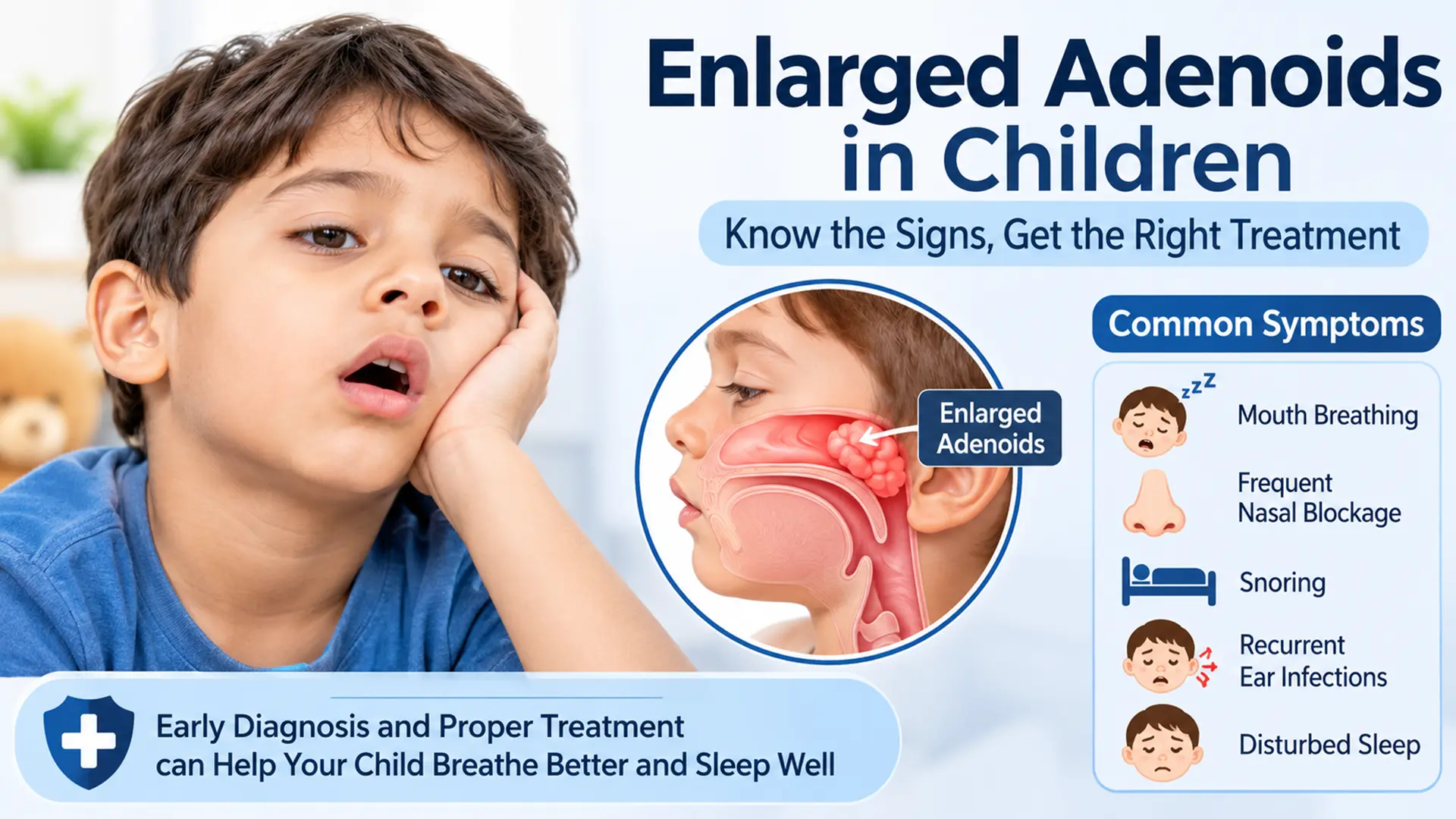
Enlarged adenoids in children are common, and many settle on their own as the child grows. They become a problem when they block the back of the nose, causing a constantly stuffy nose, mouth breathing, loud snoring or repeated ear trouble. Treatment ranges from watchful waiting and nasal sprays to a short operation called adenoidectomy for persistent or severe cases. Only an ENT examination can confirm that the adenoids are the cause.
What Are Adenoids and What Do They Do?
The adenoids are a small pad of soft lymphoid tissue high at the back of the nose, where the nasal passages join the throat. You cannot see them by looking into your child’s mouth. Like the tonsils, they are part of the immune system and are most active in early childhood.
Adenoids tend to start shrinking after about age 7, and hospital leaflets note that adenoid surgery is uncommon after age 8 because the problem often fades as the head grows. Because the space behind a young child’s nose is small, even a modest increase in adenoid size can matter, which is why problems cluster in the preschool and early school years.
Symptoms of Enlarged Adenoids in Children
Enlarged adenoids symptoms come from two things: a blocked airway behind the nose, and a blocked drainage channel for the middle ear called the Eustachian tube.
| What you notice | Why it may happen |
| A blocked nose that lasts for weeks, not just during a cold | The adenoids narrow the airway behind the nose |
| Mouth breathing, an open mouth, dry lips | Breathing through the nose is uncomfortable |
| Loud snoring, restless sleep, pauses in breathing | The airway narrows further during sleep |
| A blocked or nasal-sounding voice | Air cannot pass through the nose normally |
| Repeated ear infections, ear fluid, muffled hearing | Swollen adenoids can block the Eustachian tube |
| A runny nose, cough or bad breath that keeps returning | Chronic inflammation or infection of the adenoid tissue |
| Daytime tiredness, irritability, poor concentration | Poor-quality sleep |
Not every child with these signs has enlarged adenoids. Allergic rhinitis, repeated colds, a deviated nasal septum and enlarged tonsils can cause a very similar picture, which is why the signs of enlarged adenoids need an examination rather than a guess.
What Causes Adenoids to Enlarge?
Often no single cause is found, and several factors can add up:
- Repeated infections. Each infection can leave the adenoid tissue inflamed and larger.
- Allergies. Allergens breathed in through the nose reach the adenoid tissue, which can swell in response.
- Acid reflux. Stomach acid irritating the throat may add to adenoid inflammation, particularly in infants and young children.
- Normal childhood pattern. Adenoids are naturally most prominent in the early years.
Problems Enlarged Adenoids Can Cause
Not every child develops these problems, but they are the main reasons doctors take adenoids seriously:
- Ear problems. Blocked Eustachian tubes can lead to repeated middle-ear infections and fluid behind the eardrum. Our guide to glue ear symptoms, causes and treatment explains this in detail.
- Sleep-disordered breathing. Snoring can progress to obstructive sleep apnea, where breathing repeatedly narrows or pauses during sleep.
- Voice and breathing changes. A blocked-nose voice and constant mouth breathing.
- Long-lasting infections. Thick nasal discharge and cough from chronically infected adenoid tissue.
- Learning and speech effects. Prolonged symptoms, especially poor hearing and poor sleep, can affect a child’s development and contribute to speech and language delay.
How Doctors Diagnose Enlarged Adenoids
Diagnosis begins with a history of your child’s breathing, sleep, ear infections and hearing, followed by an examination of the ears, nose and throat. Because the adenoids are hidden, the ENT specialist may add:
- Nasal endoscopy, passing a thin camera through the nose to look at the adenoids directly, where the child can tolerate it
- A side-view X-ray of the back of the nose
- Hearing tests such as audiometry or tympanometry when ear fluid is suspected
- An allergy review, since allergy can mimic or worsen the problem
- A sleep study if obstructive sleep apnea is suspected
Treatment Options for Enlarged Adenoids
Adenoid hypertrophy treatment is not always surgical. The right choice depends on symptoms, age and how long they have lasted.
| Option | What it involves | May help when | Honest limits |
| Watchful waiting | Monitoring over weeks to months; many adenoids shrink with age | Mild symptoms; ear fluid in a child with no risk factors (guidelines advise about 3 months of observation) | Symptoms may continue, so follow-up matters |
| Saline and nasal steroid spray | Daily sprays prescribed by a doctor | Moderate to severe nasal blockage when surgery is not urgent | A Cochrane review of 6 trials (394 children) found benefit in 5, but long-term effect is not defined. In one case series, about a quarter of treated children still needed surgery within a year. Dryness, crusting or nosebleeds can occur |
| Treating allergy or reflux | Allergy medicines or reflux measures, if these are present | Symptoms that flare with allergy or after meals | Does not remove the adenoids themselves |
| Adenoidectomy | Removal of adenoid tissue under general anesthesia | Persistent obstruction, chronic adenoid infection, sleep apnea, or ear fluid in a child aged 4 or older | Surgical and anesthesia risks, and a small chance of regrowth |
When Is Adenoid Surgery Considered?
Surgery is usually reserved for severe or long-lasting problems. Two guidelines shape the decision:
- Ear fluid. For children under 4, guidelines advise against adenoidectomy for ear fluid alone unless there is a distinct reason such as nasal obstruction or chronic adenoiditis. From age 4, ear tubes, adenoidectomy or both can be considered.
- Sleep apnea. In children with obstructive sleep apnea and enlarged adenoids and tonsils, American Academy of Pediatrics guidance names adenotonsillectomy as first-line treatment. Nasal steroids are an option for mild cases or when surgery is not suitable.
If surgery is advised, you can read about the process, risks and cost factors on our page for adenoidectomy treatment in Delhi. To plan ahead, our adenoidectomy recovery time guide explains the first two weeks at home.
Surgery: benefits and drawbacks
- Possible benefits: easier breathing through the nose, less snoring, and in children aged four and over, fewer episodes of ear fluid. Benefits cannot be guaranteed for any individual child.
- Drawbacks: general anesthesia, one to two weeks of recovery, a small risk of bleeding, temporary nasal-sounding speech in a few children, and possible regrowth of adenoid tissue.
When to See a Doctor
Book an ENT visit if your child has:
- A blocked nose that lasts more than a few weeks
- Snoring on most nights, or restless sleep
- Repeated ear infections, or any sign of hearing difficulty or delayed speech
- A nose blocked on one side only
Seek urgent care for pauses in breathing during sleep, noisy or labored breathing, blue lips, or extreme sleepiness in the daytime.
What You Can Do at Home While You Decide
- Use saline spray or rinses and any prescribed nasal spray exactly as advised
- Keep your child away from tobacco smoke and dust where possible
- Note how many nights per week your child snores and how often ear infections occur. A short video of your child’s breathing at night helps the doctor
- Do not give over-the-counter decongestant drops for long periods without medical advice
Talk to an ENT Specialist in Delhi
If your child’s symptoms are persistent, an examination is the quickest way to find out whether the adenoids are responsible. Dr. Varun Rai, an ENT surgeon at Sir Ganga Ram Hospital, offers an adenoidectomy consultation in Delhi to explain every option, including waiting.
Address: Department of ENT and Head & Neck Surgery, Room No. F-77, First Floor, OPD Block (Old Building), Sir Ganga Ram Hospital
Phone: +91 7042501444 | Make an appointment
Medical disclaimer: This article is for general information and does not replace advice from a qualified doctor. Diagnosis and treatment depend on a personal examination, and results vary from child to child.
3. FAQs
What are the first signs of enlarged adenoids in a child?
A nose that stays blocked for weeks, breathing through the mouth, snoring and restless sleep are often the first signs. Repeated ear infections, a nasal-sounding voice and a runny nose that does not clear can also point to the adenoids. These signs have other causes too, so an ENT examination is needed to confirm.
How do doctors check for enlarged adenoids?
Adenoids sit behind the nose and cannot be seen by looking in the mouth. An ENT specialist may use a thin camera passed through the nose or a side-view X-ray of the back of the nose, along with a hearing test if the ears are affected and a sleep assessment if there is heavy snoring.
What causes adenoids to swell in children?
Repeated infections, allergies and acid reflux can all irritate the adenoids and make them swell. Adenoids are also naturally prominent in early childhood. Often no single cause is found, and more than one factor may be involved.
Can enlarged adenoids go away on their own?
Often, yes. Adenoids usually start to shrink after about age 7 and are largely gone by puberty. Doctors therefore commonly start with watchful waiting or medical treatment, and reserve surgery for severe or long-lasting problems.
Do nasal sprays shrink enlarged adenoids?
Nasal steroid sprays can help some children. A Cochrane review found that most trials showed better nasal breathing and smaller adenoids in children with moderate to severe enlargement, but the long-term benefit is uncertain and some children still need surgery. They should be used only as prescribed by a doctor.
Can enlarged adenoids cause snoring and sleep apnea?
Yes. Enlarged adenoids can narrow the airway behind the nose and cause snoring, restless sleep and, in some children, obstructive sleep apnea. Breathing pauses, gasping or heavy daytime sleepiness need prompt medical assessment.
Can enlarged adenoids cause ear infections and hearing problems?
They can. Swollen adenoids may block the Eustachian tube, which ventilates the middle ear. This can lead to repeated ear infections or fluid behind the eardrum, which may muffle hearing. A hearing test is often part of the assessment.
When is adenoid surgery needed?
Surgery is usually considered when symptoms are persistent or severe despite other treatment, for example constant nasal obstruction, chronic adenoid infection, sleep apnea, or ear fluid in a child aged four or older. Guidelines advise against adenoid surgery for ear fluid alone in children under four unless there is nasal obstruction or chronic adenoiditis.
Is adenoid surgery safe for children?
Adenoidectomy is a commonly performed operation and serious problems are uncommon, but there are risks, mainly bleeding, anesthesia reactions, infection, temporary nasal-sounding speech and regrowth. An ENT surgeon will review your child’s individual risks before recommending surgery.
References
- Rosenfeld RM, Shin JJ, Schwartz SR, et al. Clinical Practice Guideline: Otitis Media with Effusion (Update). Otolaryngology-Head and Neck Surgery. 2016;154(1 Suppl):S1-S41. Used for: 3-month watchful waiting; adenoidectomy not advised for ear fluid alone under age 4 unless nasal obstruction or chronic adenoiditis; tubes, adenoidectomy or both at age 4 and above.
- Marcus CL, Brooks LJ, Draper KA, et al. Diagnosis and Management of Childhood Obstructive Sleep Apnea Syndrome. Pediatrics. 2012;130(3):576-584. Used for: adenotonsillectomy as first-line treatment; nasal steroids for mild disease.
- Zhang L, Mendoza-Sassi RA, Cesar JA, Chadha NK. Intranasal corticosteroids for nasal airway obstruction in children with moderate to severe adenoidal hypertrophy. Cochrane Database of Systematic Reviews. 2008;(3):CD006286. Used for: 6 trials, 394 children, benefit in 5; long-term efficacy not defined.
- Bitar MA, et al. Is the effect of topical intranasal steroids on obstructive adenoids transient or long-lasting? Case series and systematic review of literature. Journal of Laryngology and Otology. 2016. Used for: about a quarter of treated children needed adenoidectomy by one year in the case series.
- StatPearls. Adenoiditis. StatPearls Publishing. Used for: causes (allergy, reflux, infection), links to Eustachian tube dysfunction, recurrent ear infection, sleep apnea and voice change, and possible effects on speech and language.
- NHS hospital patient leaflets on adenoidectomy: Lancashire Teaching Hospitals (uncommon to need surgery after age 8); Royal Berkshire NHS Foundation Trust, Adenoidectomy, 2024 (adenoids shrink with age; surgery reserved for severe or chronic cases); Nuffield Health, Adenoidectomy (adenoids typically start to shrink after age 7).
- ENT UK. About Adenoid Surgery (patient information leaflet). Used for: steroid spray as an option; surgery generally avoided in very young children.

