


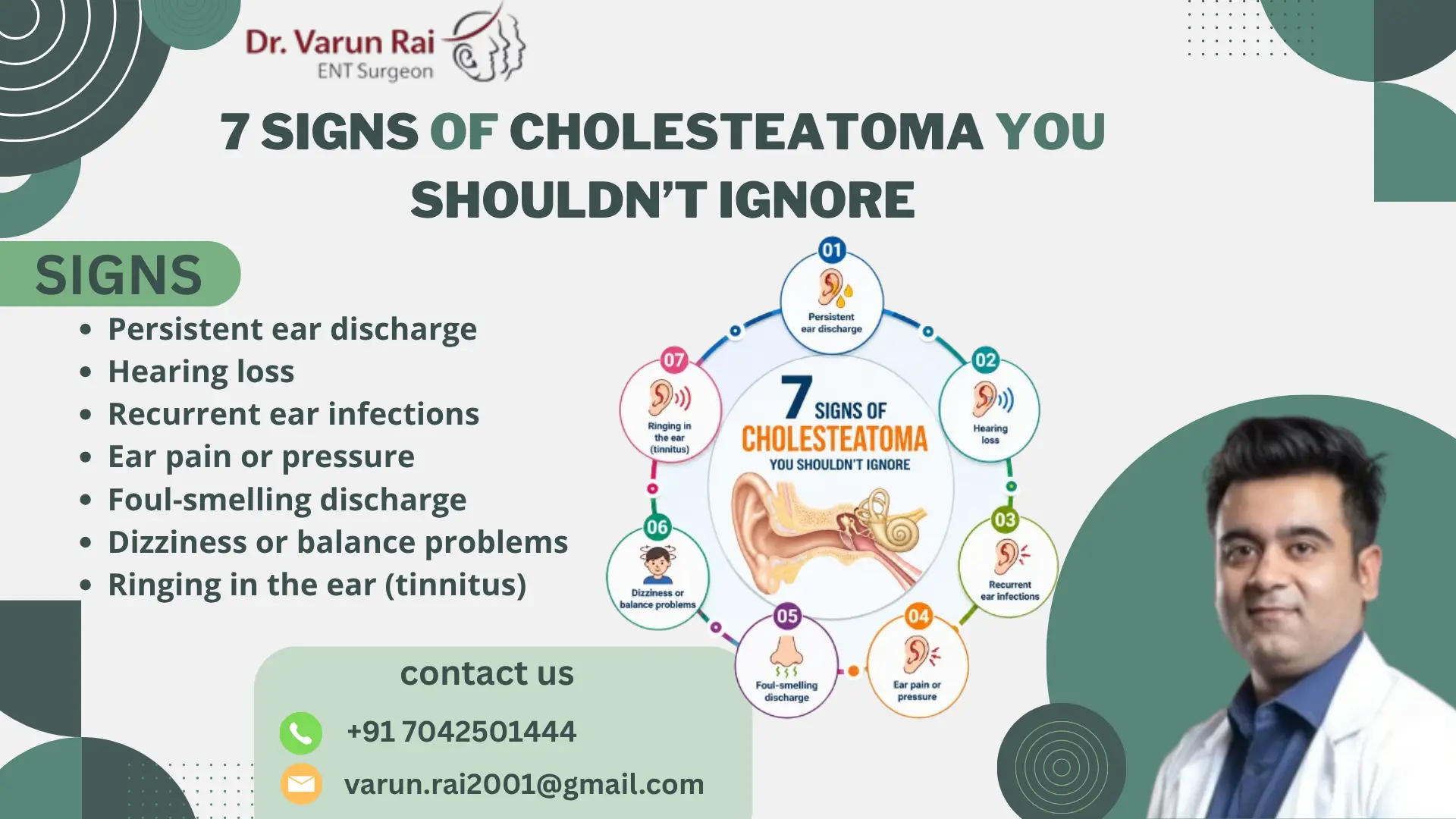
7 Signs of Cholesteatoma You Shouldn’t Ignore
A cholesteatoma is an abnormal collection of skin cells that develops inside the ear, usually in the middle ear. It is not cancer, but if left untreated, it can slowly grow and damage important parts of the ear.
Early diagnosis and treatment can help protect your hearing and reduce the risk of complications.
If you have persistent ear discharge, hearing loss, recurrent ear infections, or ear pain, it is important to consult an experienced ENT surgeon.
What Is a Cholesteatoma?
A cholesteatoma is a non-cancerous growth or collection of skin cells inside the middle ear. It commonly develops when the eardrum becomes retracted because of poor Eustachian tube function or repeated ear infections.
As this abnormal skin collection grows, it can affect the small bones of the middle ear and may cause hearing loss, chronic ear discharge, dizziness, and other ear problems.
Although it is not cancer, it should not be ignored.
7 Signs of Cholesteatoma You Shouldn’t Ignore
1. Foul-Smelling Ear Discharge
One of the most common symptoms is persistent ear discharge.
The discharge may:
- Have a bad or foul smell
- Keep coming back
- Come from only one ear
- Continue even after treatment for an ear infection
Persistent or foul-smelling ear discharge can be a warning sign of chronic middle ear disease or this condition.
If your ear is repeatedly draining, consult an ENT specialist for an examination.
2. Hearing Loss in One Ear
Another important sign is hearing loss.
The abnormal skin collection can damage or affect the tiny bones in the middle ear that help transmit sound. This may result in gradual hearing loss, particularly in one ear.
You may notice:
- Sounds becoming muffled
- Difficulty understanding conversations
- Increasing the volume of your television or phone
- Hearing better with one ear than the other
Unexplained or progressive hearing loss should always be evaluated by an ENT surgeon.
3. Recurrent Ear Infections
Do you frequently develop an ear infection in the same ear?
Repeated ear infections may be associated with chronic middle ear problems and, in some cases, this condition.
If ear infections keep returning despite treatment, an ENT specialist may need to examine the eardrum and middle ear more closely.
Do not assume that repeated ear infections are always harmless.
4. Persistent Ear Fullness or Blockage
A feeling that your ear is blocked, full, or under pressure can have several causes.
Eustachian tube dysfunction, middle ear fluid, chronic ear disease, and other conditions can cause ear fullness.
When persistent ear fullness occurs along with:
- Hearing loss
- Ear discharge
- Recurrent infections
- Ear pain
it is important to get an ENT evaluation.
5. Ear Pain or Discomfort
Ear pain is not present in every person with this condition, but some people may experience recurring pain or discomfort.
Pain may be associated with infection or inflammation around the affected ear.
If you have chronic ear pain with discharge or hearing loss, do not rely only on repeated ear drops or home remedies. A proper ENT examination can help identify the underlying cause.
6. Dizziness or Balance Problems
In some cases, the abnormal tissue can affect structures close to the inner ear.
In more advanced cases, this may result in:
- Dizziness
- Vertigo
- Balance problems
- A spinning sensation
Dizziness can have many causes, so it does not automatically mean you have this condition. However, dizziness combined with chronic ear symptoms should be evaluated by an ENT specialist.
7. Facial Weakness
Facial weakness is a less common but potentially serious sign of advanced ear disease.
The facial nerve passes close to the middle ear. In rare cases, an extensive abnormal skin collection can affect this nerve.
Symptoms may include weakness or reduced movement on one side of the face.
Facial weakness requires prompt medical evaluation.
What Causes Cholesteatoma?
This condition can develop for different reasons.
Common causes and risk factors include:
- Repeated middle ear infections
- Chronic ear infections
- Eustachian tube dysfunction
- Retraction of the eardrum
- Previous ear surgery
- Ear injury
- Rarely, congenital disease present from birth
A history of repeated ear infections does not mean you definitely have this condition. However, persistent symptoms should be checked by an ENT specialist.
Can an Ear Infection Cause Cholesteatoma?
Repeated or chronic middle ear problems can contribute to the development of this abnormal skin collection.
When the Eustachian tube does not work properly, pressure changes can cause part of the eardrum to retract inward. Skin cells can then collect in this pocket and gradually form a growth.
This is why chronic ear infections and persistent ear problems should not be ignored.
How Is Cholesteatoma Diagnosed?
An ENT surgeon can diagnose the condition through a detailed ear examination.
Depending on your symptoms, the doctor may recommend:
Ear Examination
The ENT specialist examines the ear canal and eardrum using an otoscope or microscope.
Hearing Test
An audiometry test can determine whether you have hearing loss and identify the type and severity of hearing impairment.
CT Scan of the Ear
A CT scan of the temporal bone may be recommended when the ENT specialist needs to understand the extent of the disease or plan treatment.
The tests required can vary from patient to patient.
Cholesteatoma Treatment
Treatment depends on its size, location, extent, and whether it has damaged surrounding structures.
Medicines and ear drops may be prescribed to control infection and discharge. However, they generally do not remove the underlying abnormal tissue.
In many cases, surgery may be recommended to remove the abnormal skin tissue and prevent further damage.
Your ENT surgeon will assess your ear and explain the most suitable treatment option.
Is Cholesteatoma Surgery Necessary?
In many cases, surgery is the main treatment because the abnormal skin collection needs to be removed.
The goal of surgery is to:
- Remove the abnormal tissue
- Control infection
- Prevent further damage to the ear
- Protect or improve hearing when possible
- Reduce the risk of complications
The exact surgical approach depends on the individual patient’s condition.
What Happens If Cholesteatoma Is Left Untreated?
An untreated abnormal skin collection can continue to grow and damage structures inside the ear.
Possible complications include:
- Progressive hearing loss
- Damage to the middle-ear bones
- Chronic ear infection
- Dizziness or balance problems
- Inner-ear damage
- Facial nerve problems
- Rarely, serious infections involving nearby structures
This is why early diagnosis is important.
When Should You See an ENT Surgeon?
Do not ignore persistent ear symptoms.
You should consult an ENT specialist if you experience:
- Foul-smelling ear discharge
- Repeated ear discharge
- Hearing loss in one ear
- Recurrent ear infections
- Persistent ear pain
- Ear fullness or blockage
- Dizziness or balance problems
- Facial weakness
Early assessment can help identify the cause of your symptoms and determine whether further testing or treatment is required.
Consult Dr. Varun Rai for Ear and ENT Problems
Dr. Varun Rai is an experienced ENT surgeon specializing in sinus surgery and Sialendoscopy. If you are experiencing persistent ear discharge, hearing loss, recurrent ear infections, or other concerning ear symptoms, a proper ENT evaluation can help determine the underlying cause.
Do not ignore ongoing ear problems or repeatedly self-treat them without medical evaluation.
Book a consultation with Dr. Varun Rai for expert evaluation and personalized treatment guidance.
Frequently Asked Questions About Cholesteatoma
Is cholesteatoma dangerous?
A cholesteatoma is not cancerous, but it can become serious if it grows and damages important structures of the ear. Early diagnosis and appropriate treatment can help reduce the risk of complications.
What are the first symptoms of cholesteatoma?
Common early symptoms may include persistent or foul-smelling ear discharge, hearing loss, recurrent ear infections, ear fullness, and ear discomfort.
Can cholesteatoma cause hearing loss?
Yes. The abnormal skin collection can affect the small bones of the middle ear and interfere with sound transmission, resulting in hearing loss.
Can cholesteatoma be treated without surgery?
Treatment depends on the individual case. Medicines may help control infection and discharge, but they generally do not remove the abnormal tissue itself. In many cases, surgery is recommended.
Can cholesteatoma come back after surgery?
Yes, this condition can recur in some patients. Regular follow-up with an ENT specialist is important after treatment.
Is ear discharge always a sign of cholesteatoma?
No. Ear discharge can occur because of several conditions, including ear infections. However, persistent or foul-smelling ear discharge should be evaluated by an ENT specialist.
Can cholesteatoma cause dizziness?
An advanced case may affect structures involved in balance and can cause dizziness or vertigo. However, dizziness has many possible causes and requires proper evaluation.

