


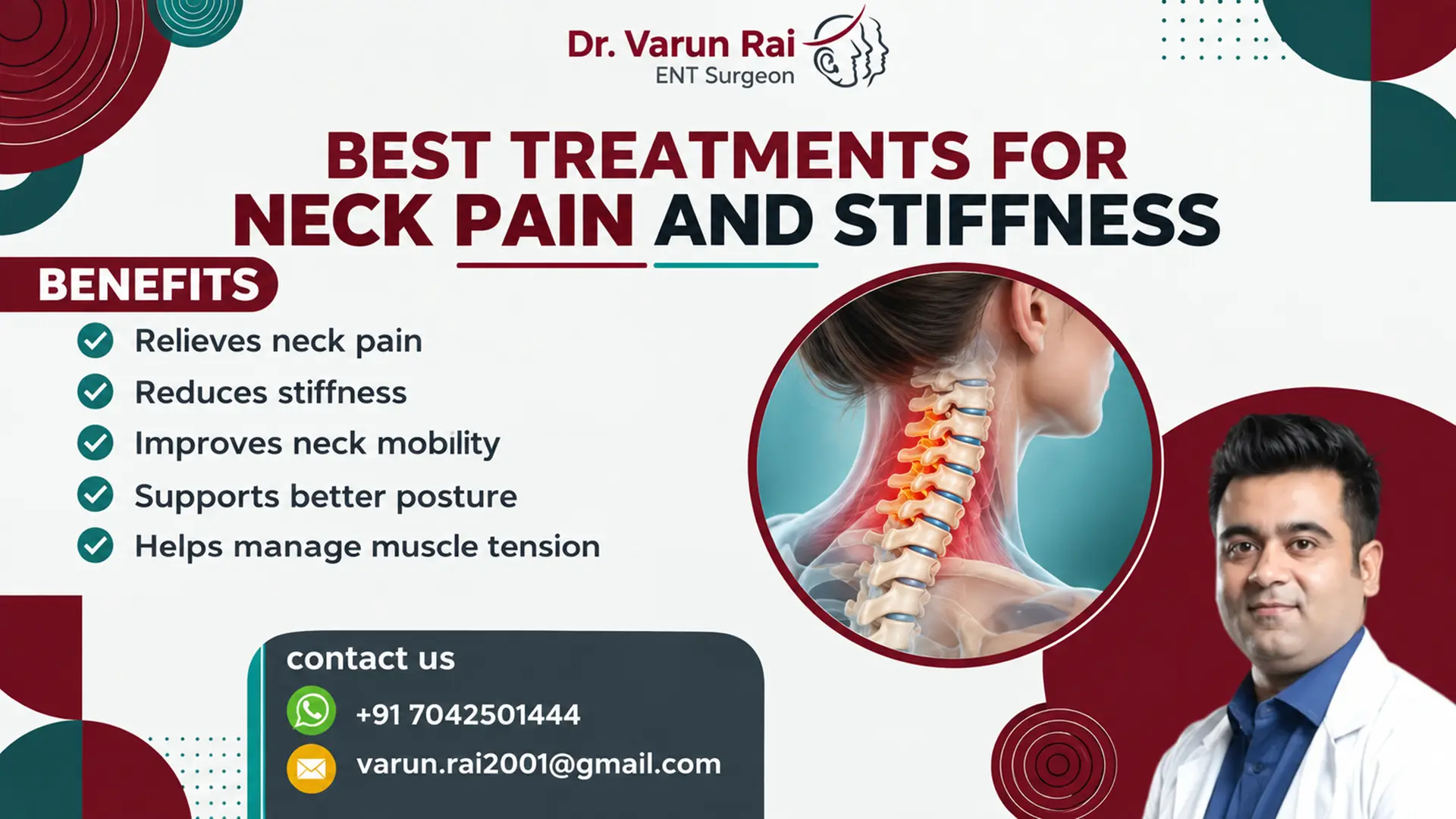
Neck pain and stiffness are common problems that can affect people of all ages. Long hours at a computer, prolonged smartphone use, poor posture, awkward sleeping positions, muscle strain, injuries, and age-related changes in the cervical spine can all contribute to discomfort. In some cases, pain may also be related to nerve compression or conditions involving nearby structures of the head, neck, throat, or salivary glands.
Understanding the underlying cause is important because the right Neck Pain Treatment depends on whether the problem is muscular, spinal, nerve-related, injury-related, or associated with another condition.
This guide explains Best Treatments for Neck Pain and Stiffness, including common symptoms, causes, diagnosis, treatment options, recovery, and when specialist evaluation may be necessary.
Symptoms and Causes of Neck Pain and Stiffness
Common symptoms
Neck pain may develop gradually or appear suddenly after an injury. Symptoms can vary depending on the underlying cause.
Common symptoms include:
- Pain or aching in the neck
- Neck stiffness or reduced flexibility
- Muscle tightness or spasms
- Pain that increases after prolonged sitting
- Difficulty turning or bending the head
- Headache associated with neck tension
- Shoulder or upper-back discomfort
- Pain extending toward the arm
- Tingling, numbness, or weakness in an arm
Pain that travels into an arm or is associated with numbness or weakness can indicate possible nerve involvement and should be medically assessed.
Common causes
There is no single cause of neck pain. Some of the most common include:
Poor posture: Spending extended periods looking down at a phone or working at a computer can place additional stress on the neck muscles and cervical structures.
Muscle strain: Repetitive movements, exercise, prolonged static positions, or sleeping in an awkward position may strain neck muscles.
Cervical spondylosis: Age-related wear and tear involving the discs and joints of the cervical spine can contribute to chronic pain and stiffness.
Pinched nerve: A bulging disc or bone spur can place pressure on a nerve and cause pain, tingling, or numbness that travels toward the arm.
Whiplash and injuries: Sudden forward-and-backward movement of the neck during a road accident or fall can injure soft tissues.
Other medical conditions: Less commonly, inflammatory disorders, infections, or other diseases can cause neck pain. Persistent or unusual symptoms therefore require proper assessment.
For people experiencing Best Treatments for Neck Pain and Stiffness, identifying the actual cause is more important than simply treating the pain temporarily.
Diagnosis and Treatment Options
How is neck pain diagnosed?
A healthcare professional usually begins with a detailed medical history and physical examination. The examination may assess tenderness, muscle strength, sensation, reflexes, and the range of neck movement.
Depending on symptoms, additional tests may include:
- X-ray: Helps assess bones and certain degenerative changes.
- MRI: Provides detailed images of discs, nerves, the spinal cord, and other soft tissues.
- CT scan: Can provide detailed information about bony structures.
- EMG: May help evaluate suspected nerve involvement.
- Blood tests: May be appropriate when infection or inflammation is suspected.
Not every person with neck pain requires imaging. Imaging findings should be interpreted alongside symptoms and clinical examination because structural changes can sometimes exist without causing pain.
Treatment and procedures
The most appropriate Neck Pain Treatment depends on the cause and severity of symptoms.
1. Activity modification and posture correction
For mild pain, reducing activities that aggravate symptoms while maintaining comfortable movement can help. Improving workstation ergonomics, keeping screens at an appropriate height, and avoiding prolonged neck flexion can reduce unnecessary strain.
2. Heat and cold therapy
Cold packs may be useful during the early phase after some injuries, while heat can help relax tight muscles. Packs should be wrapped in a towel and used for limited periods.
3. Medicines
Depending on the patient’s medical history, a doctor may recommend appropriate pain-relieving or anti-inflammatory medicines. Prescription medicines or muscle relaxants may sometimes be considered when simpler measures are insufficient. Medication should be taken only according to professional advice or label directions.
4. Physiotherapy
Physiotherapy is an important component of Chronic Neck Pain Treatment for many patients. A qualified physiotherapist can develop exercises to improve mobility, posture, flexibility, and muscle strength.
5. Injections and minimally invasive procedures
For selected patients with persistent pain caused by nerve or joint-related problems, a specialist may consider targeted injections or other minimally invasive procedures. These treatments should only be performed after an appropriate diagnosis.
6. Surgery
Surgery is generally not the first choice for routine neck pain. It may be considered when there is significant nerve or spinal cord compression, neurological deterioration, or persistent symptoms that do not respond adequately to conservative treatment.
What role does an ENT specialist play?
Not all pain or pressure perceived around the neck originates from the cervical spine. Symptoms involving the throat, salivary glands, swallowing, voice, sinus region, or other ENT structures may sometimes be experienced around the head and neck.
This is where an experienced ENT specialist can be valuable when the symptoms suggest an ENT-related cause.
Dr. Varun Rai is a Consultant ENT specialist associated with Sir Ganga Ram Hospital. His areas of interest include endoscopic sinus and skull-base surgery, micro-ear surgery, salivary gland disorders, sialendoscopy, and voice and swallowing disorders. His training includes sialendoscopy and minimally invasive salivary gland surgery.
His services include evaluation and treatment related to sinus problems, endoscopic sinus surgery, salivary gland disorders, sialendoscopy, ear conditions, voice and swallowing disorders, snoring and sleep-related problems, among other ENT conditions.
Importantly, patients with typical cervical spine-related neck pain may need evaluation by a musculoskeletal, orthopedic, neurology, or spine specialist rather than an ENT specialist. Dr. Varun Rai’s role is particularly relevant when neck discomfort is associated with ENT symptoms or when an ENT cause needs to be assessed.
Benefits, Recovery and Comparison of Treatments
Benefits of appropriate treatment
Choosing treatment based on the underlying cause can provide several potential benefits:
- Reduced pain and stiffness
- Improved neck mobility
- Better posture and muscle function
- Improved ability to work and perform daily activities
- Reduced recurrence in some cases
- Earlier identification of nerve-related or other significant conditions
- Avoidance of unnecessary invasive treatment
For Best Treatments for Neck Pain and Stiffness, a gradual, cause-specific approach is generally preferable to immediately pursuing an invasive procedure.
Recovery
Recovery depends on the underlying problem. Mild muscle-related neck pain may improve within a few weeks with conservative measures. Mayo Clinic notes that many mild-to-moderate cases improve within two to three weeks with simple treatment.
Patients with chronic conditions may require a longer rehabilitation programme involving physiotherapy, exercise, ergonomic correction, and management of contributing factors.
After a procedure or surgery, recovery will depend on the specific treatment performed. Patients should follow their clinician’s instructions regarding activity, medication, wound care, exercises, and follow-up.
Comparing common treatment approaches
| Treatment | Usually considered for | Main objective |
| Posture correction | Mild/postural pain | Reduce mechanical strain |
| Heat/cold therapy | Muscle discomfort or recent symptoms | Relieve pain and tightness |
| Medication | Short-term symptom control | Reduce pain/inflammation |
| Physiotherapy | Persistent or recurrent pain | Improve mobility and strength |
| Targeted injections | Selected persistent pain | Reduce inflammation/pain |
| Surgery | Significant nerve/spinal cord compression or selected structural problems | Address the underlying structural cause |
| ENT evaluation | Neck/throat symptoms suggesting ENT origin | Identify or treat ENT-related causes |
The best option is not necessarily the most advanced treatment. Best Treatments for Neck Pain and Stiffness should be selected according to the diagnosis, symptom severity, duration, overall health, and response to previous treatment.
When should you seek medical attention?
Seek urgent medical care for severe neck pain following a significant injury, or when neck pain is accompanied by serious neurological symptoms such as significant weakness or difficulty walking. Severe neck pain with fever may also require urgent assessment.
A routine medical evaluation is advisable when pain persists for several weeks, repeatedly returns, becomes progressively worse, or is associated with numbness, tingling, weakness, or pain radiating into an arm.
FAQs About Neck Pain Treatment
1. What are the Best Treatments for Neck Pain and Stiffness?
The best treatment depends on the cause. Posture correction, activity modification, physiotherapy, medicines, and targeted procedures may all have a role. Severe or persistent cases require professional evaluation before selecting treatment.
2. What is the best treatment for chronic neck pain?
Chronic Neck Pain Treatment may involve physiotherapy, posture correction, strengthening exercises, appropriate medication, and treatment of an underlying spinal or nerve problem. A personalised treatment plan is usually more effective than relying on painkillers alone.
3. Can poor posture cause neck pain?
Yes. Prolonged forward-head posture while using computers or smartphones can increase stress on neck muscles and cervical structures and contribute to pain and stiffness.
4. Is physiotherapy effective for neck pain?
Physiotherapy can help improve neck movement, posture, flexibility, and muscle strength. It is commonly included in conservative management for persistent neck pain.
5. When does neck pain require an MRI?
An MRI may be considered when symptoms suggest a disc, nerve, spinal cord, or other soft-tissue problem. The decision should be based on the clinical examination and symptoms rather than neck pain alone.
6. Can neck pain cause headaches?
Yes. Neck muscle tension and certain cervical conditions can be associated with headaches. However, recurrent or severe headaches should be properly evaluated rather than automatically attributed to the neck.
7. Can an ENT specialist treat neck pain?
An ENT specialist does not generally treat cervical spine or muscular neck pain. However, an ENT evaluation may be appropriate when symptoms involve the throat, sinuses, salivary glands, swallowing, voice, or other head-and-neck structures.
8. What does Dr. Varun Rai specialise in?
Dr. Varun Rai is an ENT specialist with interests including endoscopic sinus and skull-base surgery, sialendoscopy and salivary gland disorders, micro-ear surgery, and voice and swallowing disorders.
9. When should I see a doctor for neck stiffness?
Consult a doctor if stiffness does not improve after several weeks, keeps returning, becomes severe, or occurs with numbness, tingling, weakness, radiating arm pain, fever, or other concerning symptoms.
Conclusion
Best Treatments for Neck Pain and Stiffness depend on identifying the reason behind the symptoms rather than treating every case in the same way. Mild muscular or postural pain may improve with movement, ergonomic correction, heat or cold therapy, and appropriate conservative care. Persistent pain, neurological symptoms, injuries, or suspected structural problems require professional evaluation.
It is also important to remember that not every symptom felt in the neck originates from the cervical spine. Problems involving the sinuses, throat, salivary glands, swallowing mechanism, or other ENT structures may require assessment by an ENT specialist.
For patients with relevant ENT-related head and neck symptoms, Dr. Varun Rai, ENT specialist, offers expertise in sinus surgery, sialendoscopy, salivary gland disorders, ear surgery, and voice and swallowing conditions.
Book an appointment with Dr. Varun Rai for an expert ENT evaluation and personalised treatment plan. For persistent cervical spine-related neck pain, seek assessment from the appropriate spine, orthopedic, neurology, or musculoskeletal specialist.

